
Lesser Spotted Woodpecker Project in Gloucestershire and Avon - March 2026 Update
Last year, Birds on the Brink awarded a grant to Rufus Dawson for the study of Lesser Spotted Woodpeckers. Here, Rufus provides us with an update on the project’s progress.
Brief Summary
We are now quite a long way into the data collection part of the project. At this stage, a cumulative total of 72 acoustic recorders have been deployed across 24 sites in the project region. Lesser Spotted Woodpecker Dryobates minor (LSW) have been recorded at many of these, including many unexpected ones – though their absence at some of the most promising looking sites may be a cause for concern about the future of the species in the county.
Crunching the humidity-vocalisation data, habitat measurements and verifying all the classifier detections is still to come and so I do not have a total number of LSW-positive sites yet. However, below I list a few initial thoughts and potential, unverified findings.
A Note on Geographical Distribution
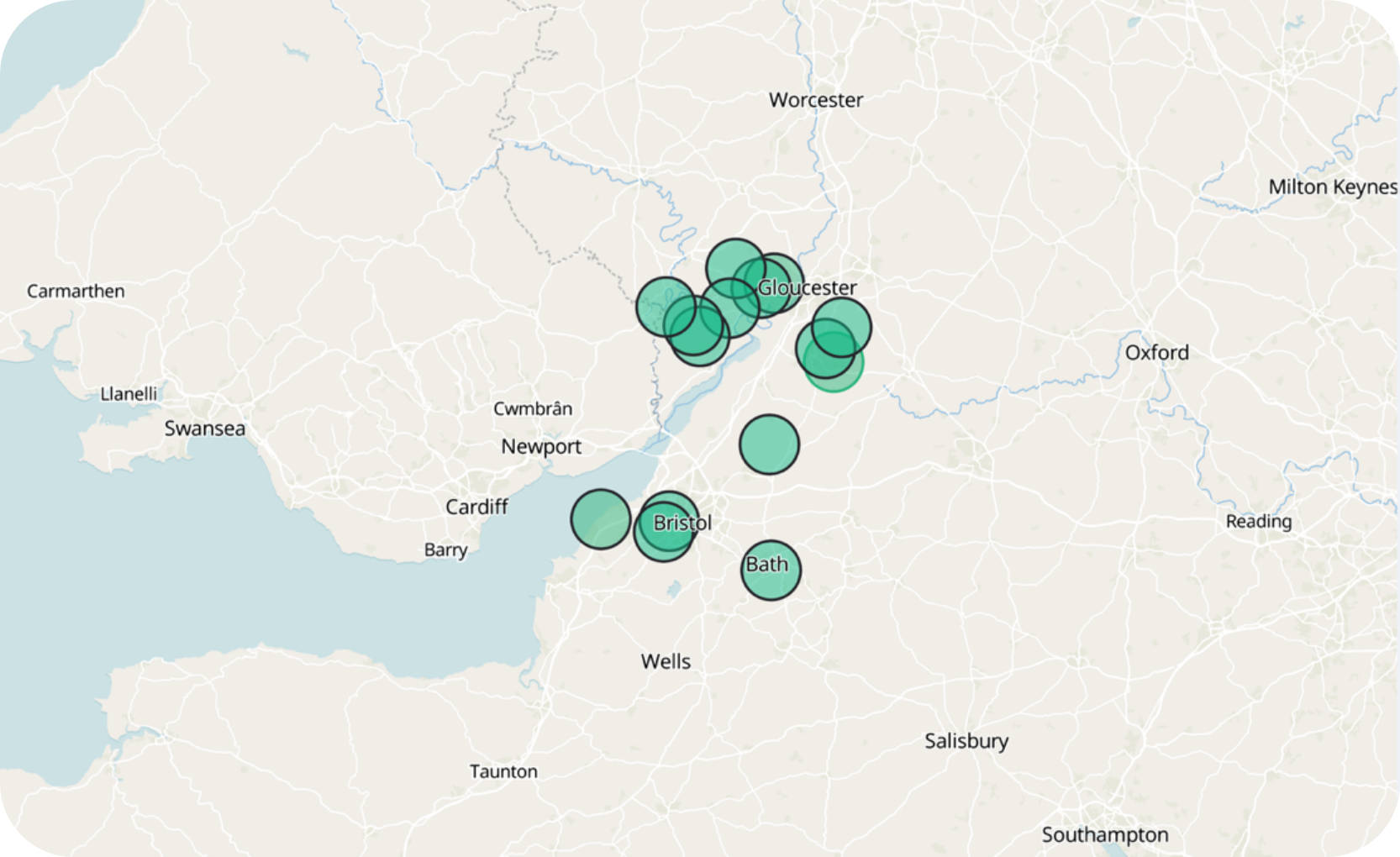
Above: Study sites in the region (please note that sites have been generalized due to restrictions on data sharing from data providers)
You will notice on the map above that recorders have been placed at only one site in the south Cotswolds. This is regrettable, and I should like to emphasise that there are almost certainly just as many birds in this area as in the north Cotswolds. However, a significant part of the region is private land – so there is a real shortage of observer data on which to decide where to put the recorders. It would be interesting to see the results of a survey specifically targeting this area, however, as there is a significant extent of suitable habitat – but this would require a whole project in itself.
A few weeks ago, I visited several notable private sites around the Stroud area. Even at midday (when I was deploying the recorders) I heard a short burst of LSW drumming.
It seems increasingly likely that the mid-Cotswold area is a county hotspot for the birds – although there have been decades of significant under-recording. This is especially notable as almost all Cotswold woodlands are beech-dominated – far from the ‘traditional’ habitat for the birds in the UK.
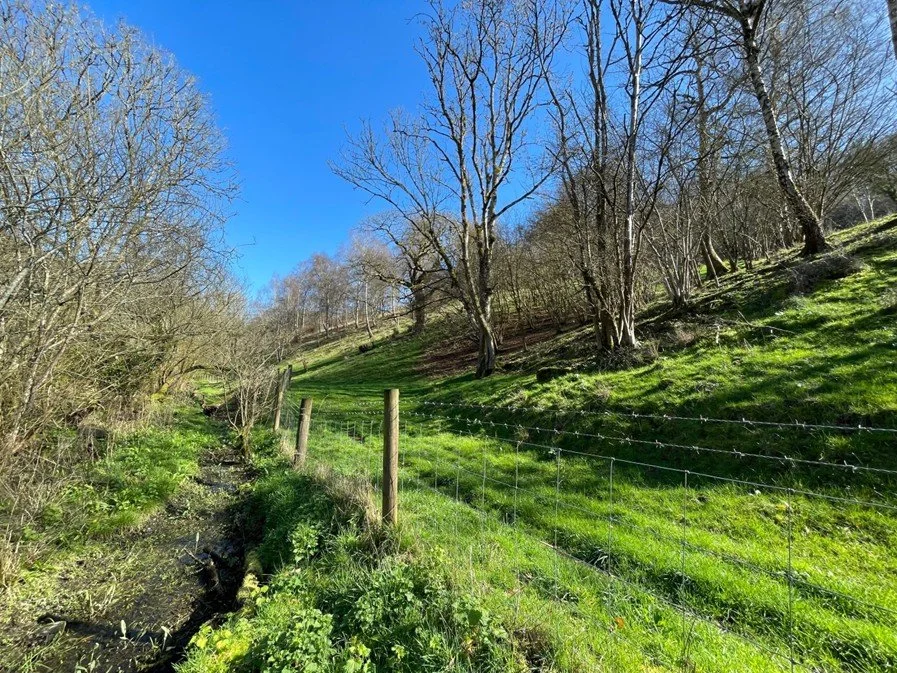
Above: The proposed ‘feeding area’ at a private Cotswold site. Many LSW vocalisations (mainly calls) were detected during daytime hours – ie 11am until 4pm. Note the birch strip on the bank (on the horizon), and the willow beds to the left of the image. The birch strip continues for about half a kilometer beyond this point. Photo Rufus Dawson.
In fact, the vast majority of LSW research in the country has focused on the New Forest and parts of the South East – where birds are generally found in extensive W10 wet woodlands. In Gloucestershire, this is not relevant, as birds do not have these extensive wet woodlands and so utilise a patchwork of different habitats. For example, this might be a beechwood for drumming and a riparian strip for feeding.
By placing song meters in different habitats, it is exciting to start to build up a picture of spatial usage by LSW at these sites.
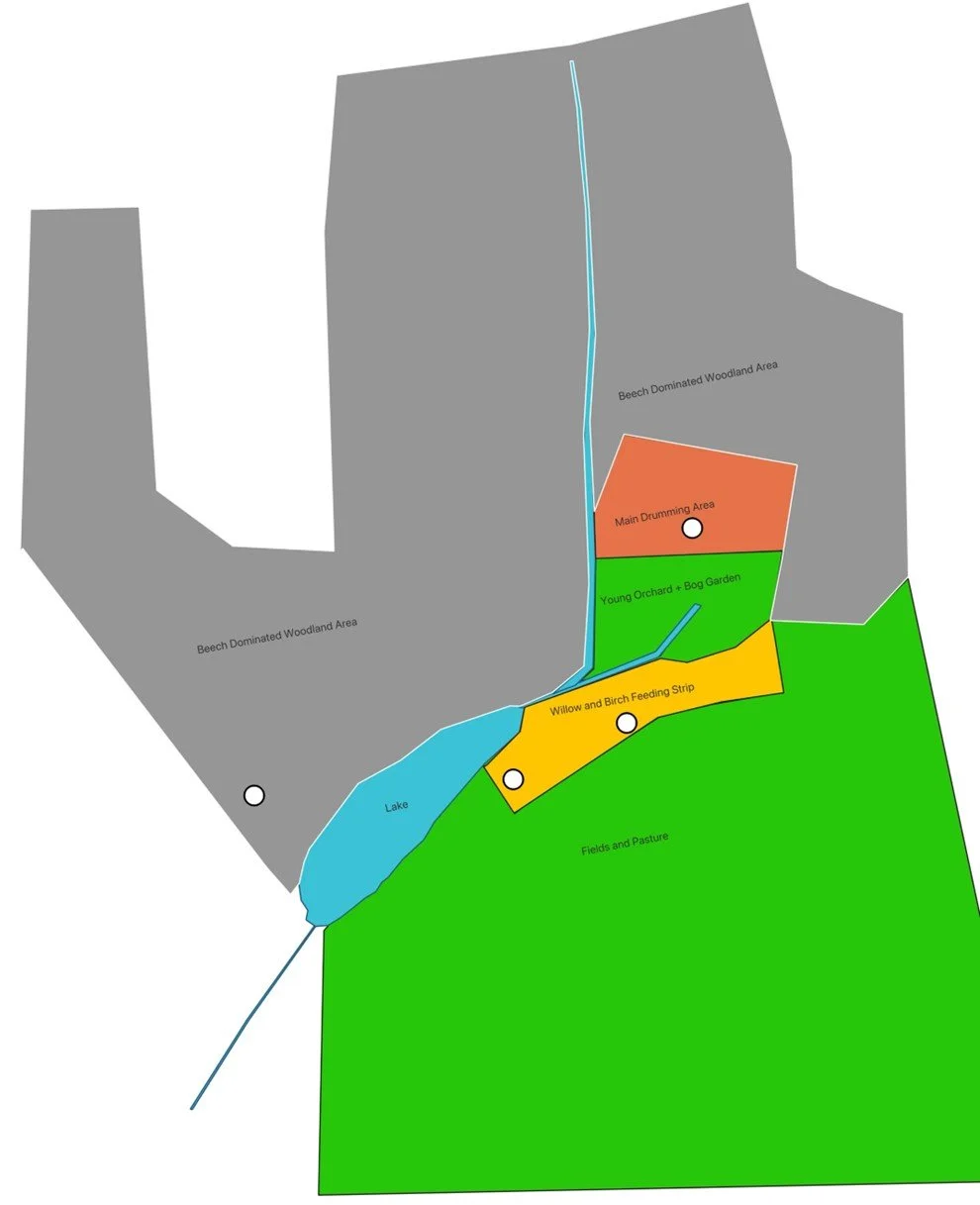
A map of the site photographed in the image below. The white circles show locations at which LSW were detected. The labels show habitat and/or their potential significance to the birds.
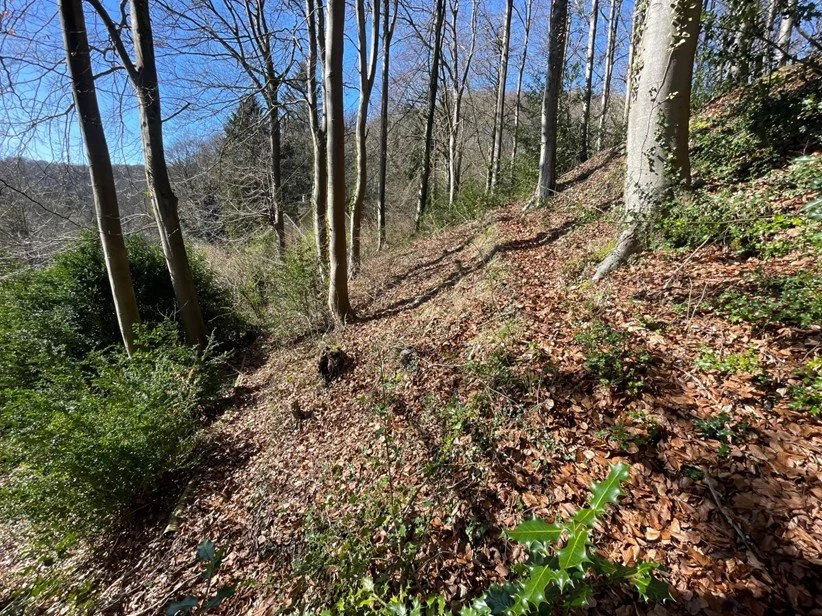
Above: The proposed ‘drumming area’ at the same site as above. Birds were detected drumming in here on 7 of the 9 days the recorders were in position. This beechwood is unremarkable in the Cotswolds. The only reason why it differs from anywhere else within the Cotswolds Commons and Beechwoods area is its 300m proximity to the ‘feeding area’ above. Photo: Rufus Dawson.
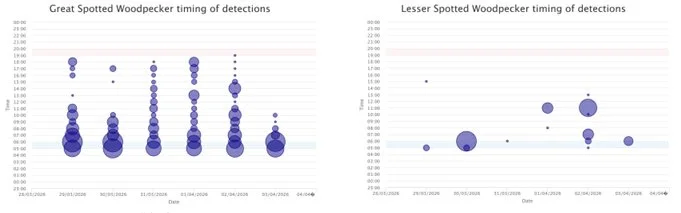
Above: Vocalisation of Lesser Spotted Woodpeckers in the study areas.
Whilst carrying out the project, it has been interesting to analyse the timings of LSW vocalisations. Passive acoustic monitoring (PAM) enables accurate, long-term measuring of this data, which is otherwise very hard to collect reliably in a quantitative form. Above shows the time-vocalisation data of one of the processed sites. It is interesting to see the results for both species side-by-side.
It comes as no surprise that LSW vocalised the most at dawn (represented on the graph by the blue line), and in the two hours of the day that follow. What is quite notable, however, is how little they vocalised in the evenings and around dusk. Such behavior is quite commonplace for the species – and whilst not the peak vocalisation time, a smaller peak in LSW vocalisations is generally expected during this time period.
Is this just a peculiar anomaly, or a more widespread behaviour in isolated populations of Lesser Spotted Woodpeckers with a reduced need to show territorial behaviour? Hopefully as the data from more sites is analysed we will get a clearer picture of how common a trend this is in the county.
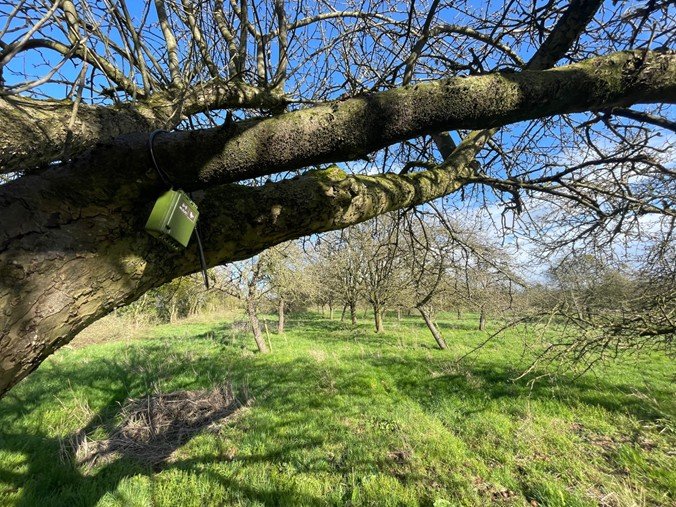
A recorder in a private orchard near Gloucester. Photo Rufus Dawson.
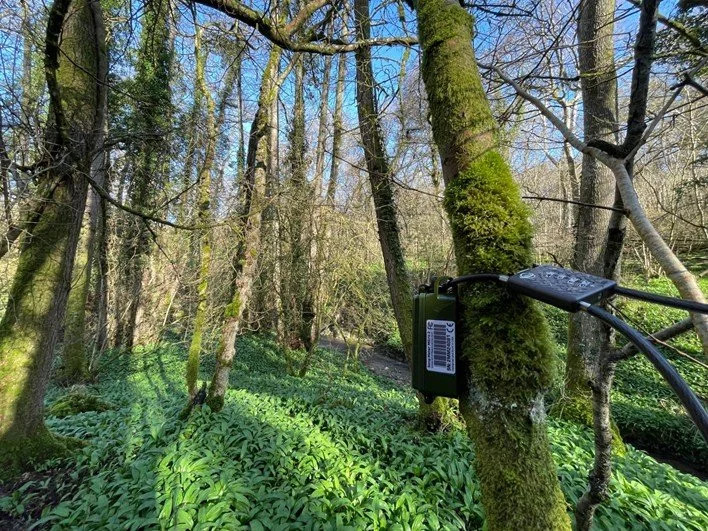
A recorder in a riparian alder woodland in Avon. Photo Rufus Dawson.
Rufus ended his update by saying ‘I would like to thank Birds on the Brink and all its supporters for continued support of the project. The data collection stage will wrap up in a couple of weeks’ time, at which point I will start reviewing everything. The next update you will see will be the final report’.
